
This guide covers every menu you can see on your own screen, in the order it appears in your sidebar. Each entry explains what the page is for and the exact steps to carry out its actions. For learners.
1. Signing in
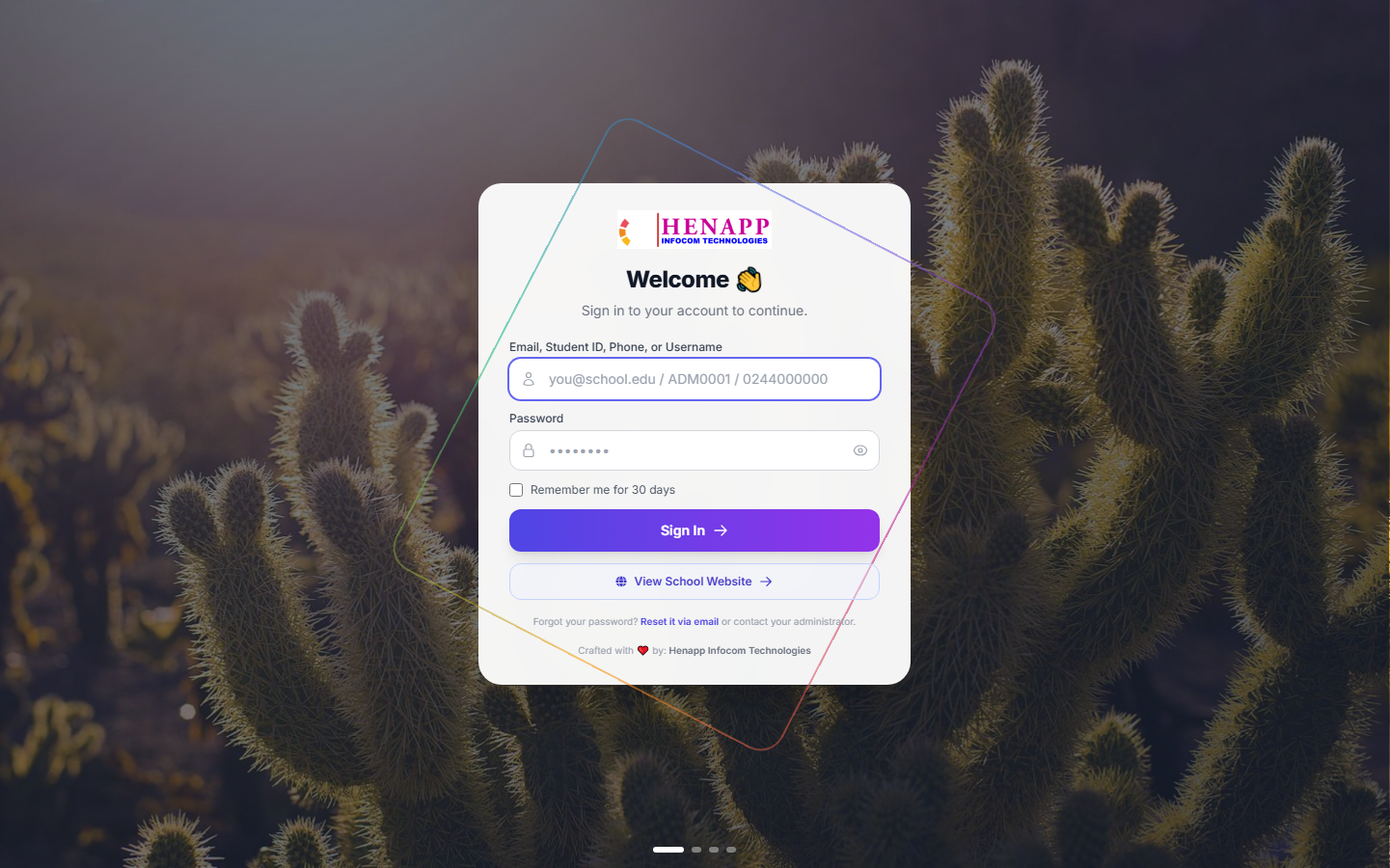
Your school gives you a web address, your email or username, and a first-time password. Open the address in any modern browser — Chrome, Edge, Safari or Firefox — on a phone, tablet or computer.
How to sign in
- Open your school portal address. If you were given a link, tap it.
- Type your email address or username in the first box.
- Type your password in the second box. Passwords are case-sensitive.
- Tick "Remember me" only on a device nobody else uses.
- Click Sign In.
If you forget your password
- Click "Forgot password?" on the sign-in page — if your school has email set up, a reset link is sent to you.
- Otherwise ask the school office to reset it. They can issue you a new temporary password.
The system asks you to set your own password the first time you sign in. Choose something only you know, and never share it — everything you do is recorded against your name.
2. Finding your way around

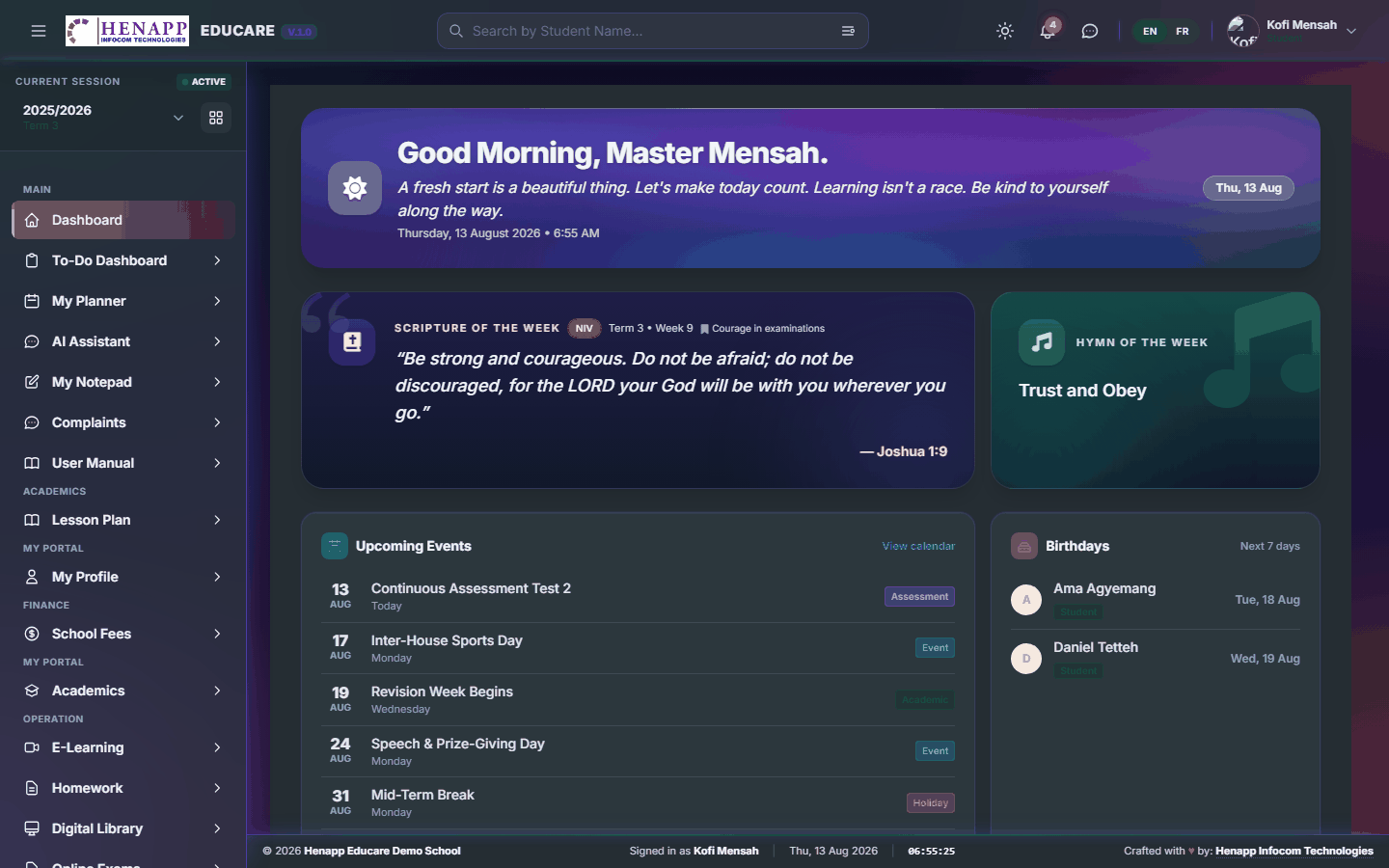
After signing in you land on your dashboard. Everything else is reached from the sidebar on the left and the bar across the top.
The sidebar
- The sidebar lists every part of the system you are allowed to use. What you see here is exactly what this guide covers — nothing more, nothing less.
- Click a heading to open its submenus; click again to close it.
- On a phone, tap the ☰ menu icon at the top-left to slide the sidebar in and out.
The top bar
- Academic year and term selector — nearly every page shows data for the year and term chosen here. If figures look wrong or a list looks empty, check this first.
- Search — jump to any page or person by name.
- Sun / moon icon — switch between light and dark appearance.
- Bell icon — your notifications.
- Your name and photo — profile, and Sign out.
3. Your profile and password
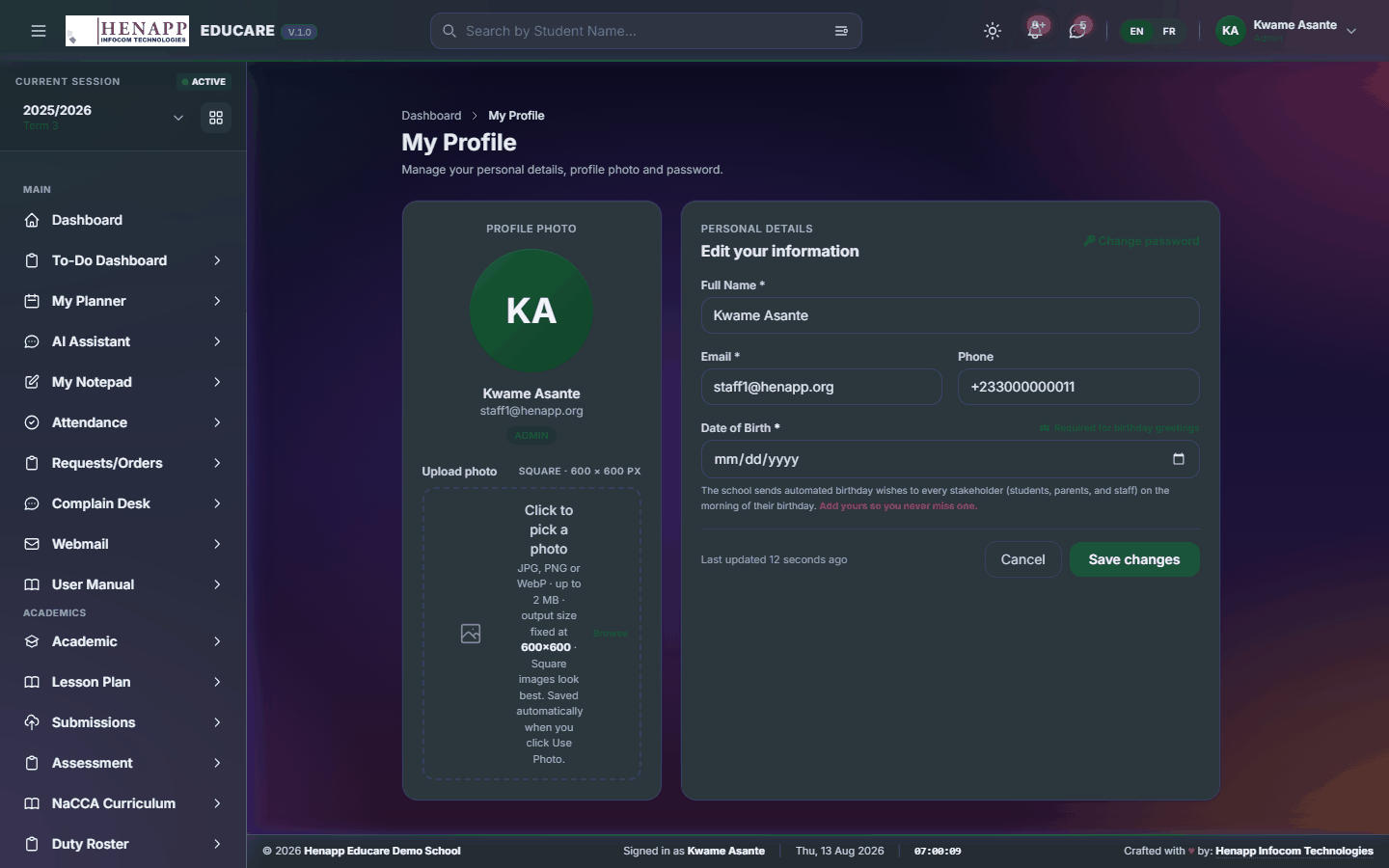
Your profile holds your contact details, your photo and your password.
How to update your details
- Click your name at the top-right, then Profile.
- Edit your phone number, address or other details and click Save.
- Click your photo to upload a new one — a clear head-and-shoulders picture works best.
How to change your password
- Open your profile and find the Change Password section.
- Type your current password, then your new password twice.
- Click Update Password. You stay signed in on this device.
On a school, library or family computer, click your name and choose Sign out when you finish. Closing the tab alone does not sign you out.
4. Dashboard
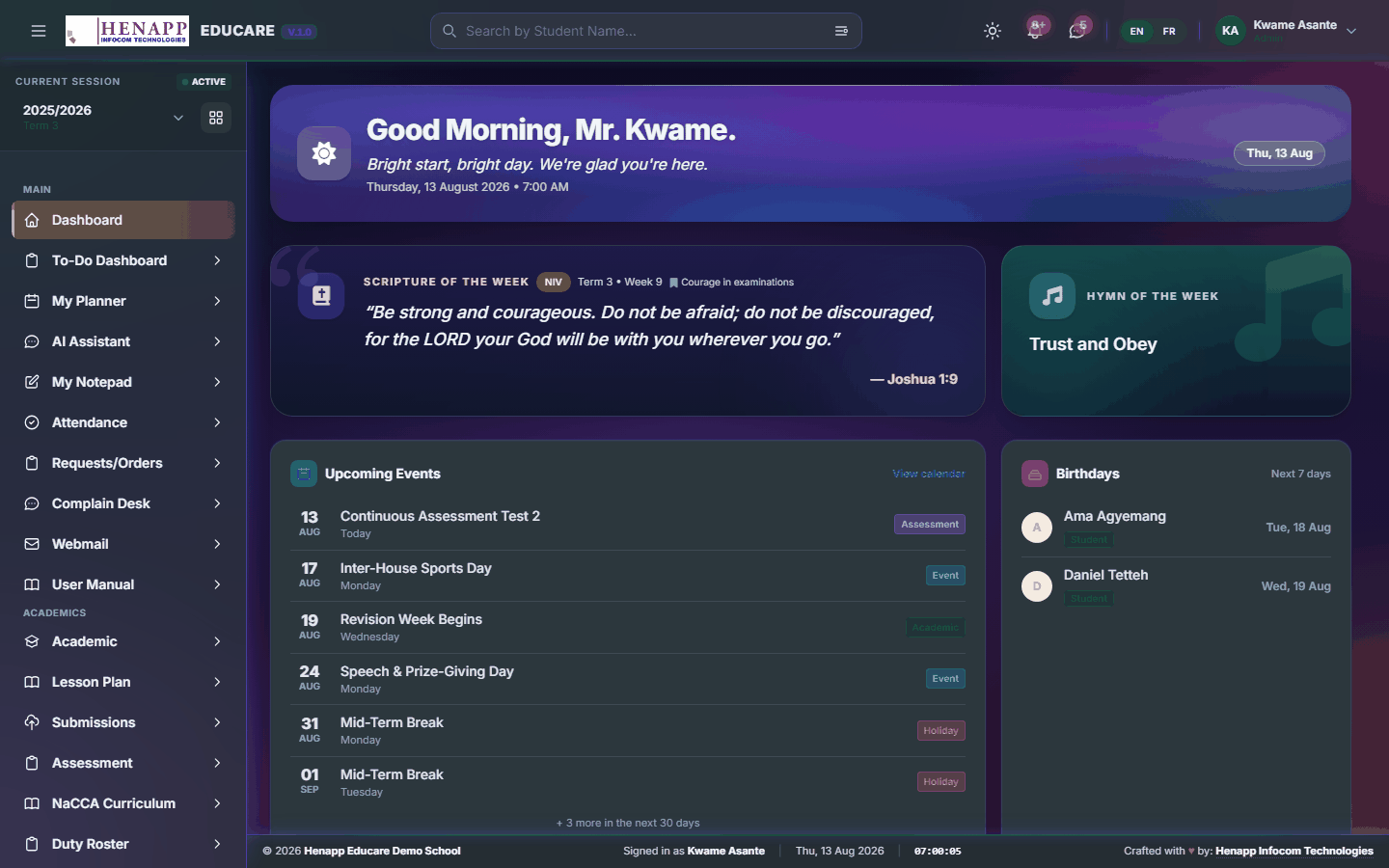
Your home page. It summarises what needs your attention today and links straight to the pages that answer it.
Find it in the sidebar under Main → Dashboard.
4.1 Dashboard
The first page after you sign in. The cards you see depend on your role — the important thing is that each one is a shortcut: click it to open the page behind the number.
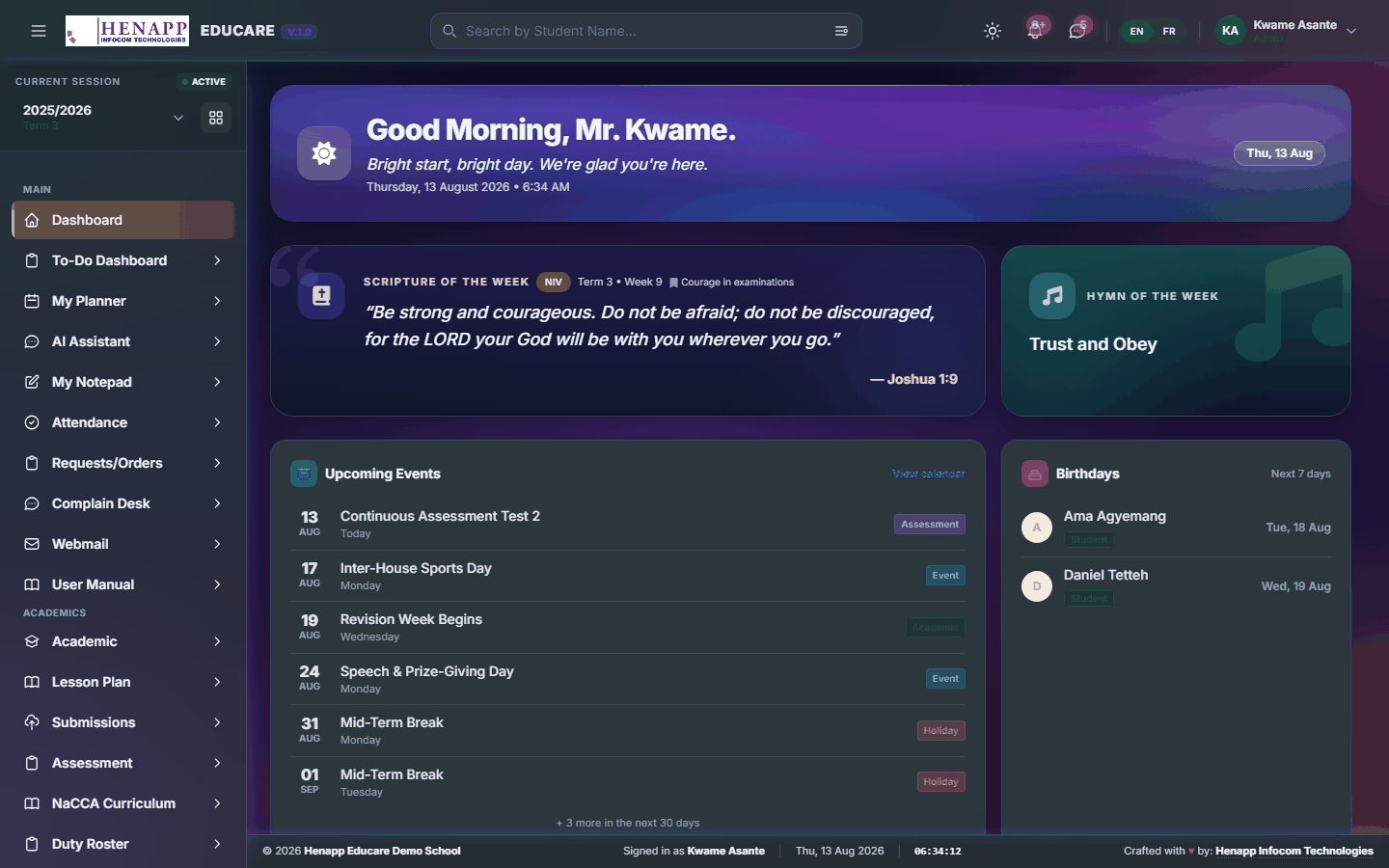
How to use it
- Read the cards along the top for the headline figures for today.
- Click any card or chart to open the full page it summarises.
- Use the academic year and term selector in the top bar to see the same dashboard for a different period.
- Scroll down for your recent activity and anything awaiting your action.
5. To-Do Dashboard
A single running list of everything the system is waiting on you for, gathered from every module.
Find it in the sidebar under Main → To-Do Dashboard.
5.1 To-Do Dashboard
Every outstanding task the system knows about, collected in one place — lesson plans not yet submitted, registers not yet marked, approvals waiting on you, forms not yet returned.

How to use it
- Open To-Do Dashboard from the sidebar.
- Each card is one kind of outstanding task, with a count.
- Click a card to open the list behind it, then work through the items.
- Items disappear from the list on their own once the underlying task is done — there is nothing to tick off here.
You only ever see tasks that are actually yours. Two teachers signed in side by side will see different counts on the same day.
6. My Planner
Your private diary inside the portal — appointments, reminders and personal deadlines that are not school-wide events.
Find it in the sidebar under Main → My Planner.
6.1 My Planner
A month, week and day diary that only you can see. Use it for anything you want to remember that is not a school-wide calendar event.

How to use it
- Open My Planner from the sidebar.
- Switch between Month, Week and Day using the buttons above the grid.
- Click any empty day or time slot to start a new entry.
- Give it a title, set the date and time, pick a colour, and Save.
- Click an existing entry to edit it, or use its delete button to remove it.
7. AI Assistant
A built-in assistant that answers questions about your own school data and drafts routine text for you.
Find it in the sidebar under Main → AI Assistant.
7.1 AI Assistant
Ask questions in plain language and get answers drawn from your school data, within the limits of what your role is allowed to see. It also drafts routine wording for you to edit — a notice to parents, a report remark, an SMS short enough to send.
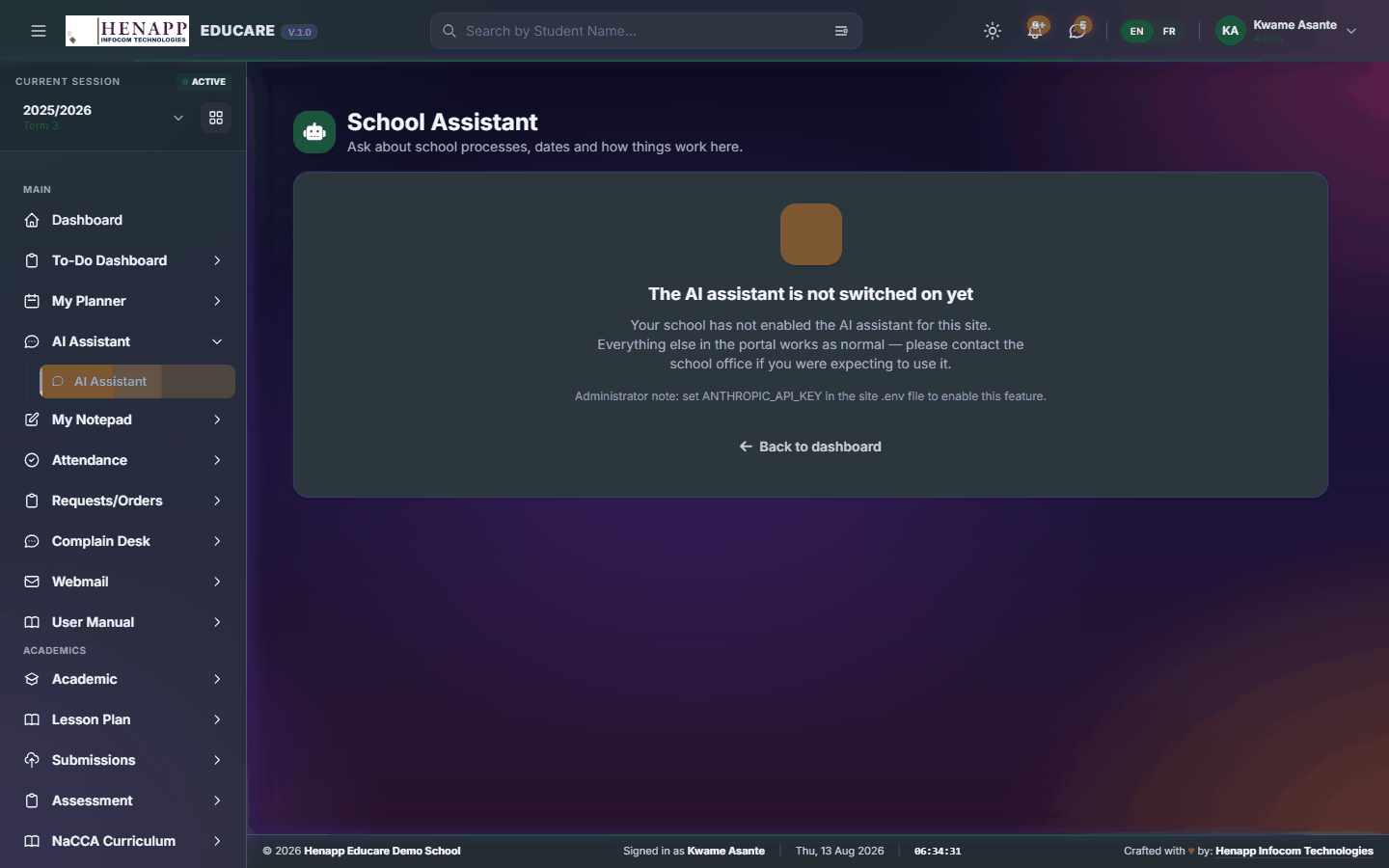
How to use it
- Open AI Assistant from the sidebar.
- Type your question or instruction in the box at the bottom and press Enter.
- Ask follow-up questions in the same conversation — it remembers what you just asked, so "now make it shorter" works.
- Your past conversations are listed down the side; click one to reopen it.
- Start a new conversation when you change subject, so earlier context does not colour the answer.
The assistant can be confidently wrong. Treat a figure it quotes as a prompt to open the real page and confirm, and read any text it drafts before you send it.
It answers only from data your role can already open. It is not a way around a permission you do not have.
If it says the assistant is not configured, no AI provider key has been set for your school — an administrator sets that under System Settings. The school can hold keys for several providers, and the system moves to the next one automatically if one is busy or over its daily limit, so the feature keeps working.
8. My Notepad
Quick private notes that stay with your account and follow you to any device you sign in on.
Find it in the sidebar under Main → My Notepad.
8.1 My Notepad
Short private notes — a phone number, a reminder, a paragraph you are drafting. Notes save as you type and are visible only to you.
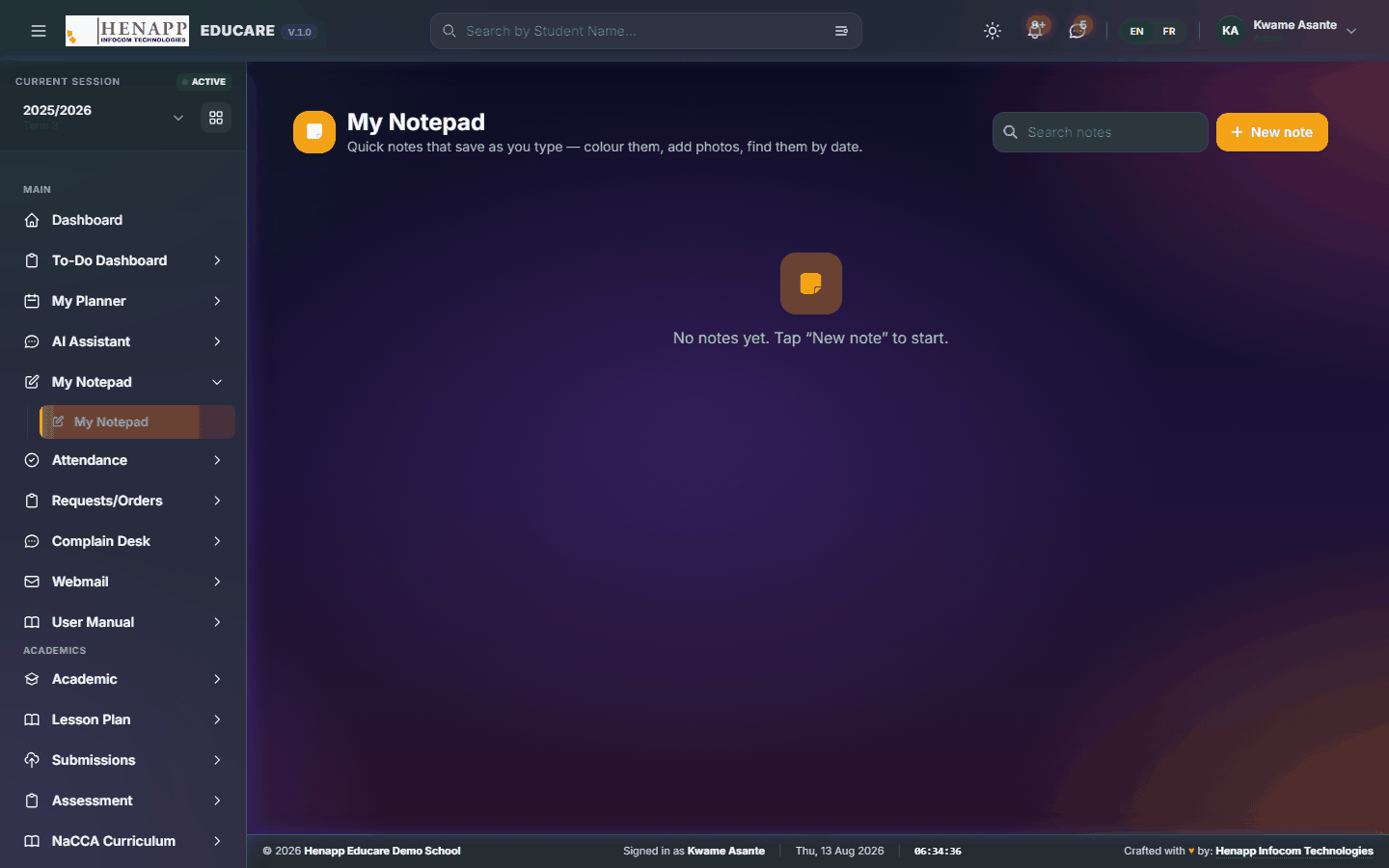
How to use it
- Open My Notepad from the sidebar.
- Click New Note, give it a title and start typing.
- Pick a colour to group related notes visually.
- Notes save automatically; use the search box at the top to find one later.
- Delete a note from its own menu when you no longer need it.
9. Complaints
Raise a concern with the school and follow the reply, privately.
Find it in the sidebar under Main → Complaints.
9.1 My Complaints
Raise a concern with the school and follow the response. Only you and the staff handling it can see the thread.

How to use it
- Open Complaints → My Complaints.
- Click New Complaint.
- Choose the category, write what happened, and Submit.
- The school's reply appears on the same thread; you are notified in the portal and by email.
10. User Manual
This manual. It is built from your own sidebar, so it documents exactly the menus you can see and nothing you cannot.
Find it in the sidebar under Main → User Manual.
10.1 User Manual
This manual. It is generated from your own sidebar, so every chapter matches a menu you actually have.
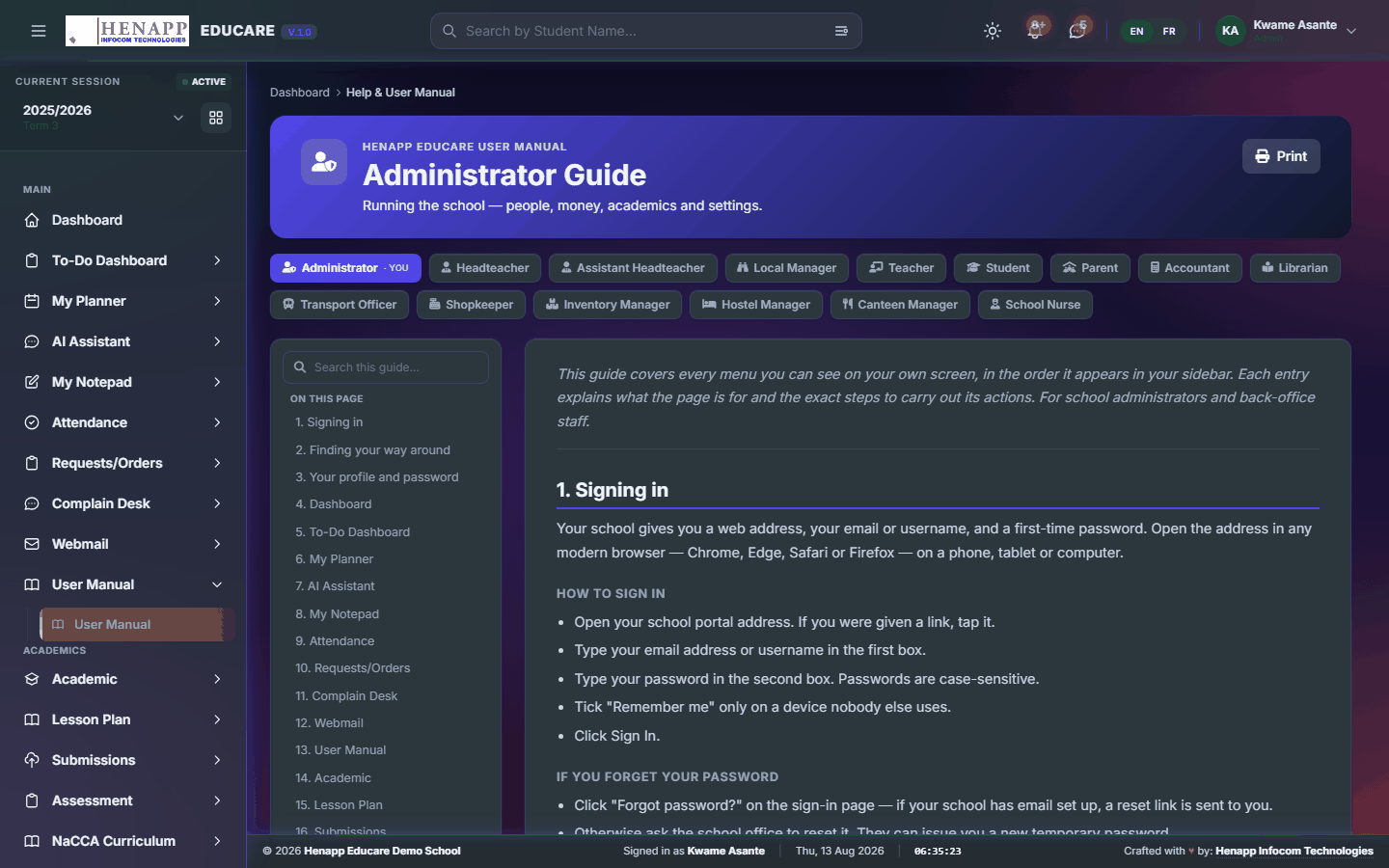
How to use it
- Open User Manual from the sidebar.
- Use the contents list on the left to jump to a chapter.
- Type in the search box to filter to the chapters that mention a word.
- Click Print for a paper copy or a PDF.
11. Lesson Plan
The teaching-planning chain, from the year's scheme of work down to the notes for a single lesson — and the tracker that shows who has submitted what.
Find it in the sidebar under Academics → Lesson Plan.
11.1 Scheme of Learning
The lesson notes your teachers have shared with the class, ready to revise from.

How to use it
- Open Lesson Plan → Lesson Notes.
- Pick the subject.
- Open a week to read its notes, or download the attachment.
11.2 Lesson Notes
The lesson notes your teachers have filed for your class, arranged in folders you can browse.
How to use it
- Open Lesson Plan → Lesson Notes.
- Open a folder to see what is inside it.
- Click a note to read it, or open the video or document attached to it.
12. My Profile
Your own learner record as the school holds it.
Find it in the sidebar under My Portal → My Profile.
12.1 My Profile
Your own record as the school holds it — your class, your details and your guardians.

How to use it
- Open My Profile.
- Check your details are right.
- Tell the school office about anything that needs correcting — this page is read-only.
13. School Fees
Your family's money with the school: what is owed, what has been paid, and the meal and transport plans you are subscribed to.
Find it in the sidebar under Finance → School Fees.
13.1 Invoices & Payments
Your invoices and what you have paid — the family account.

How to use it
- Open School Fees → Invoices & Payments.
- Choose the child if you have more than one.
- Open an invoice to see each line and the balance.
- Download or print an invoice or receipt for your records.
- Where online payment is enabled, pay from the invoice itself.
13.2 Meal Plans
Your child's meal plan — what they are subscribed to and what is being served.
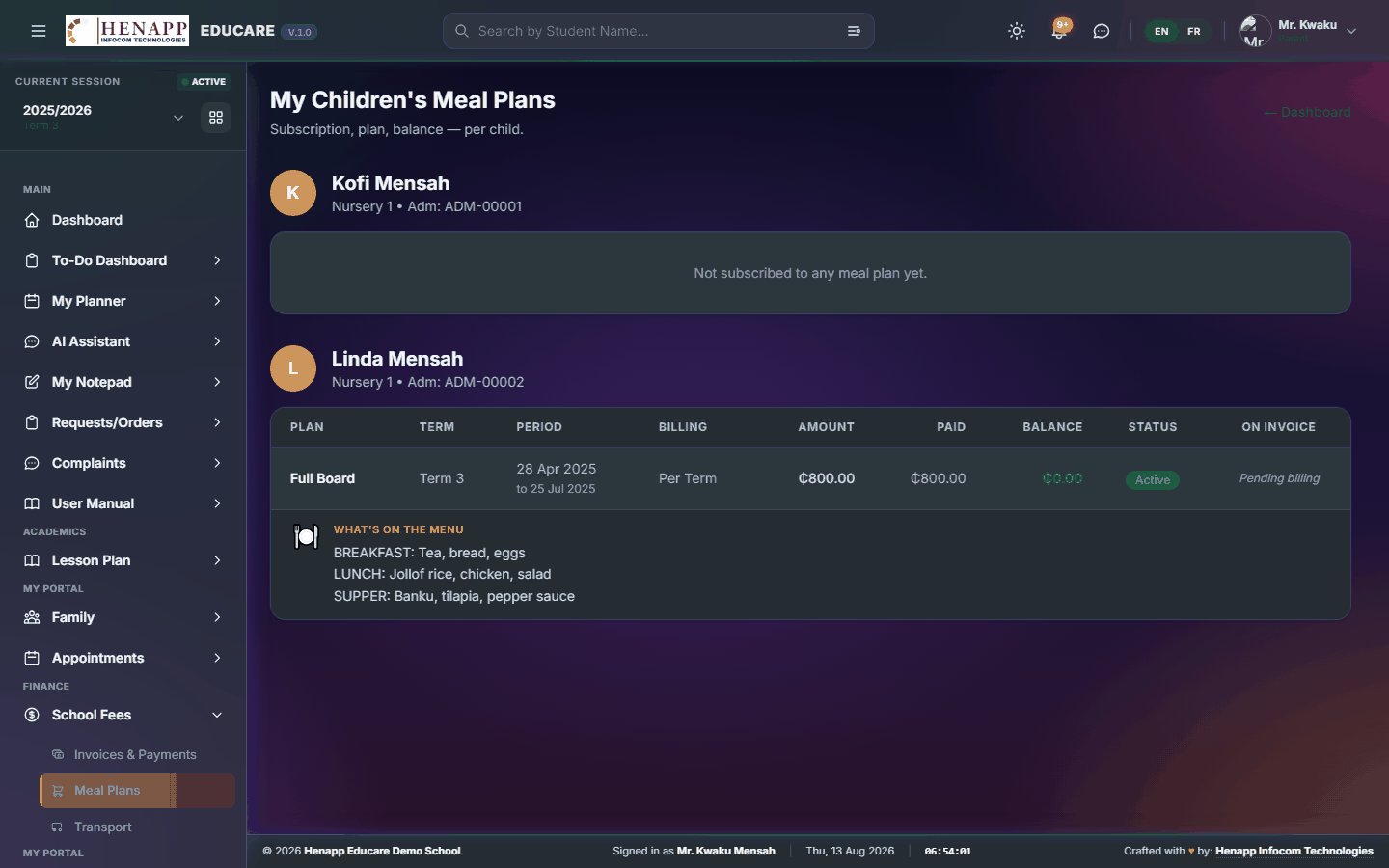
How to use it
- Open School Fees → Meal Plans.
- Choose the child.
- Read the plan and the week's menu, and see what has been charged.
13.3 Transport
Your child's transport — the route they ride and the fares charged.

How to use it
- Open School Fees → Transport.
- Choose the child.
- Read the route and the charges.
14. Academics
Your academic pages — timetables, scores, report cards and results.
Find it in the sidebar under My Portal → Academics.
14.1 Class Timetable
The class timetable — which subject is taught when.

How to use it
- Open Academics → Class Timetable.
- Choose the child if you have more than one.
- Read the week, and print it for the wall at home.
14.2 Exam Timetable
Your examination timetable — the papers you sit, and when.

How to use it
- Open Academics → Exam Timetable.
- Read each paper, its date, time and room.
- Print it or note the dates somewhere you will see them.
14.3 Academic Calendar
The school calendar — terms, holidays, examinations and events.

How to use it
- Open Academics → Academic Calendar.
- Read the term ahead and print it if useful.
14.4 Classwork Scores
Your classwork marks for the term.

How to use it
- Open Academics → Classwork Scores.
- Read your marks by subject.
14.5 Homework Scores
Your homework marks for the term.

How to use it
- Open Academics → Homework Scores.
- Read your marks by subject.
14.6 Project Work
Your project-work marks.

How to use it
- Open Academics → Project Work.
- Read your marks by subject.
14.7 Group Work
Your group-work marks — the work you did as part of a group, and what it scored.
How to use it
- Open Academics → Group Work.
- Read each piece of group work, who was in the group, and the mark it was given.
14.8 Self Verification
A read-only check of the marks recorded for you, before report cards are issued.

How to use it
- Open Academics → Self Verification.
- Choose the term and the test.
- Check each mark, and tell your teacher if something looks wrong.
14.9 My Report Cards
Your report cards, once published.
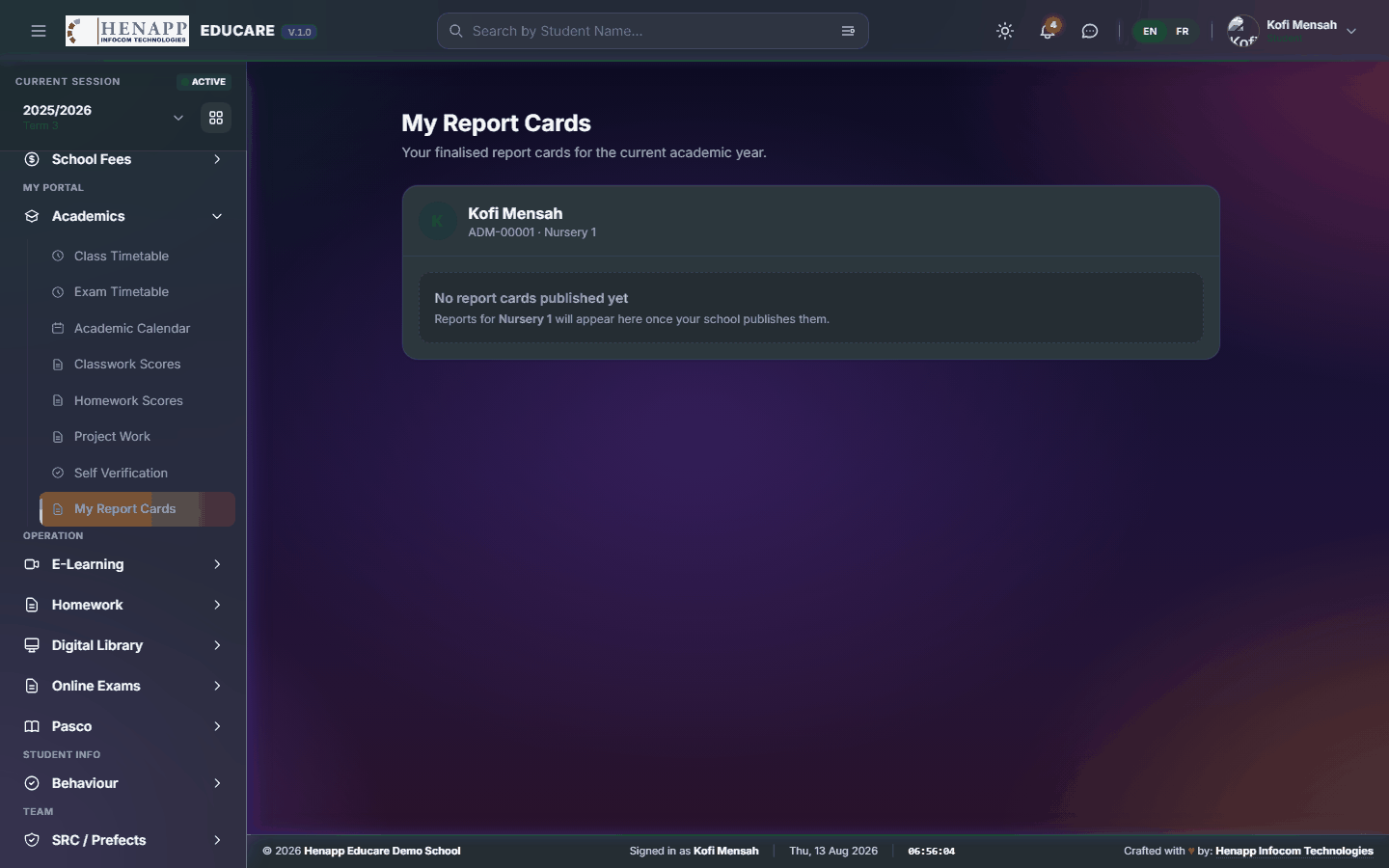
How to use it
- Open Academics → My Report Cards.
- Choose the term.
- Read the card, or download it as a PDF.
15. E-Learning
Online learning — lessons published by teachers, and how far each learner has got through them.
Find it in the sidebar under Operation → E-Learning.
15.1 LMS Overview
The e-learning home page — what is published and how it is being used.
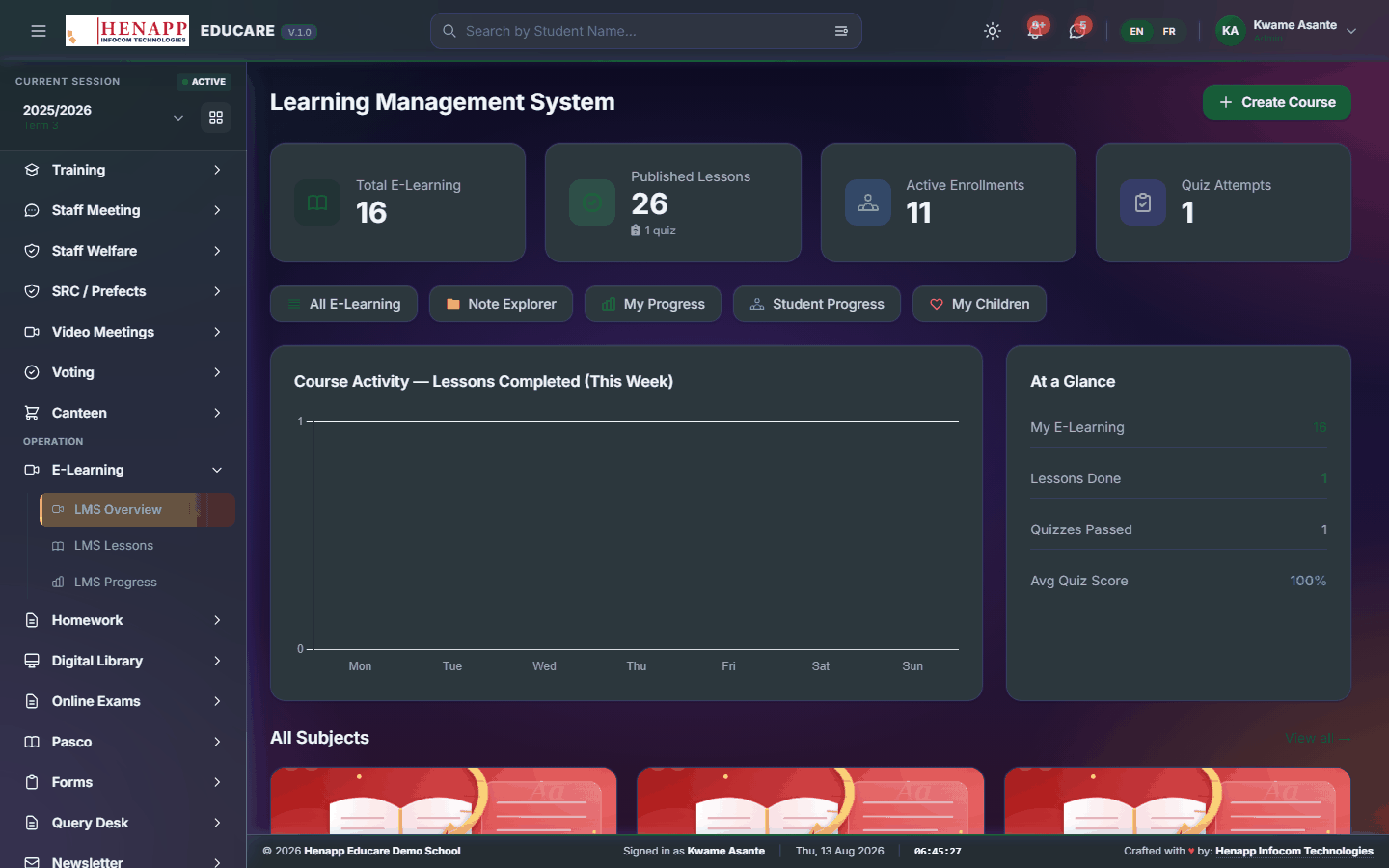
How to use it
- Open E-Learning → LMS Overview.
- Read the published lesson counts and engagement.
- Click through to a subject or lesson.
15.2 My Subjects
Your subjects, each opening into its lessons. The natural place to start.
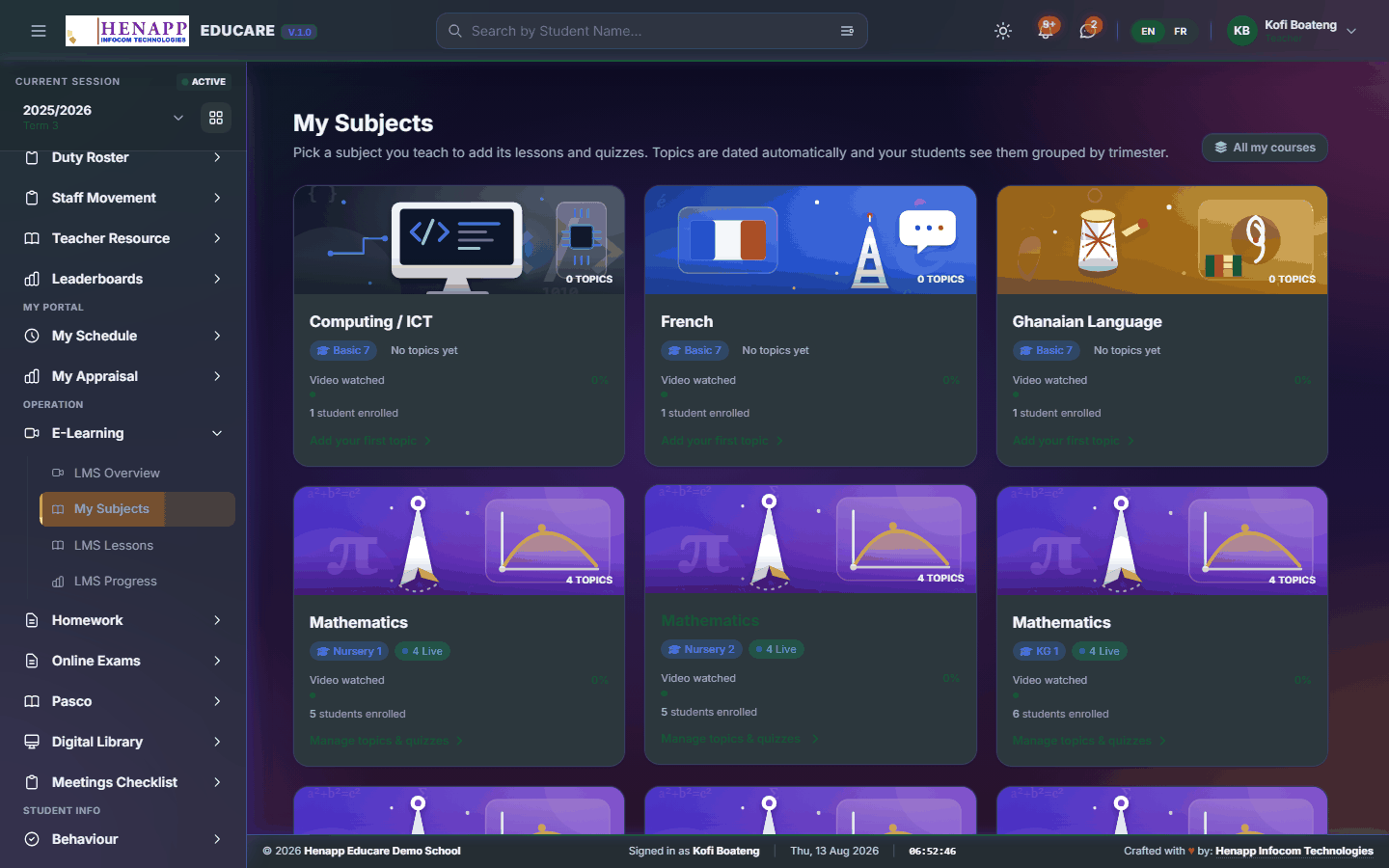
How to use it
- Open E-Learning → My Subjects.
- Click a subject to see its lessons in order.
- Open a lesson to work through it.
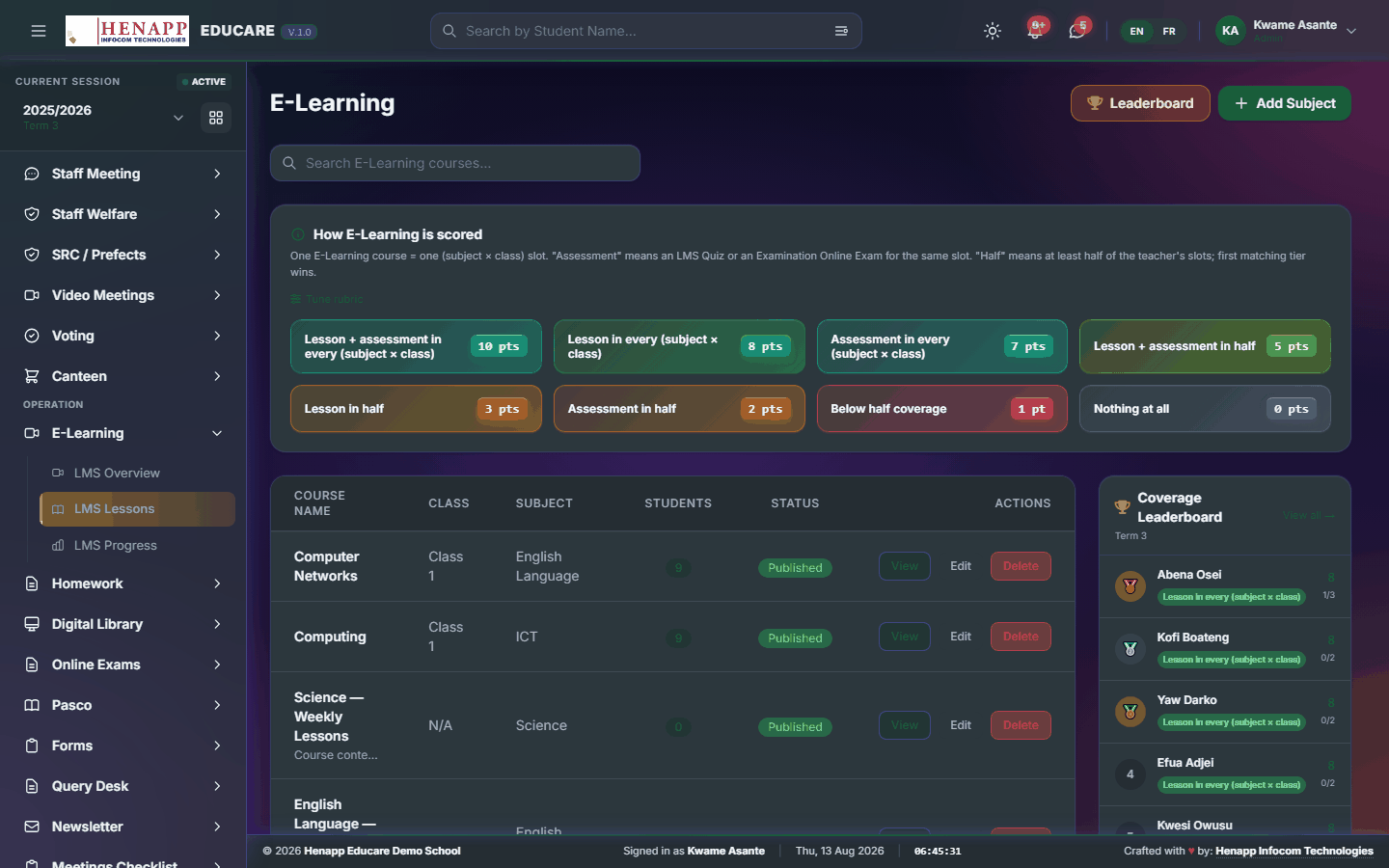
15.3 LMS Lessons
The lessons themselves — video, text, slides and attachments. Teachers create them here; learners work through them.
How to use it
- Open E-Learning → LMS Lessons.
- Learners: click a lesson to open it and work through in order. Your progress is recorded as you go.
- Teachers: click New Lesson, choose the class and subject, then add the content — text, a video link, slides or files.
- Publish when it is ready. Learners see it immediately.
16. Homework
Homework set, submitted and marked inside the system.
Find it in the sidebar under Operation → Homework.
16.1 Homework Browser
Homework across the classes you teach — set it, and see what has come back.

How to use it
- Open Homework → Homework Browser.
- Click New Homework, choose the class and subject.
- Write the instructions, attach any file, and set the due date.
- Publish. Learners and parents are notified.
- Watch submissions arrive against the assignment.
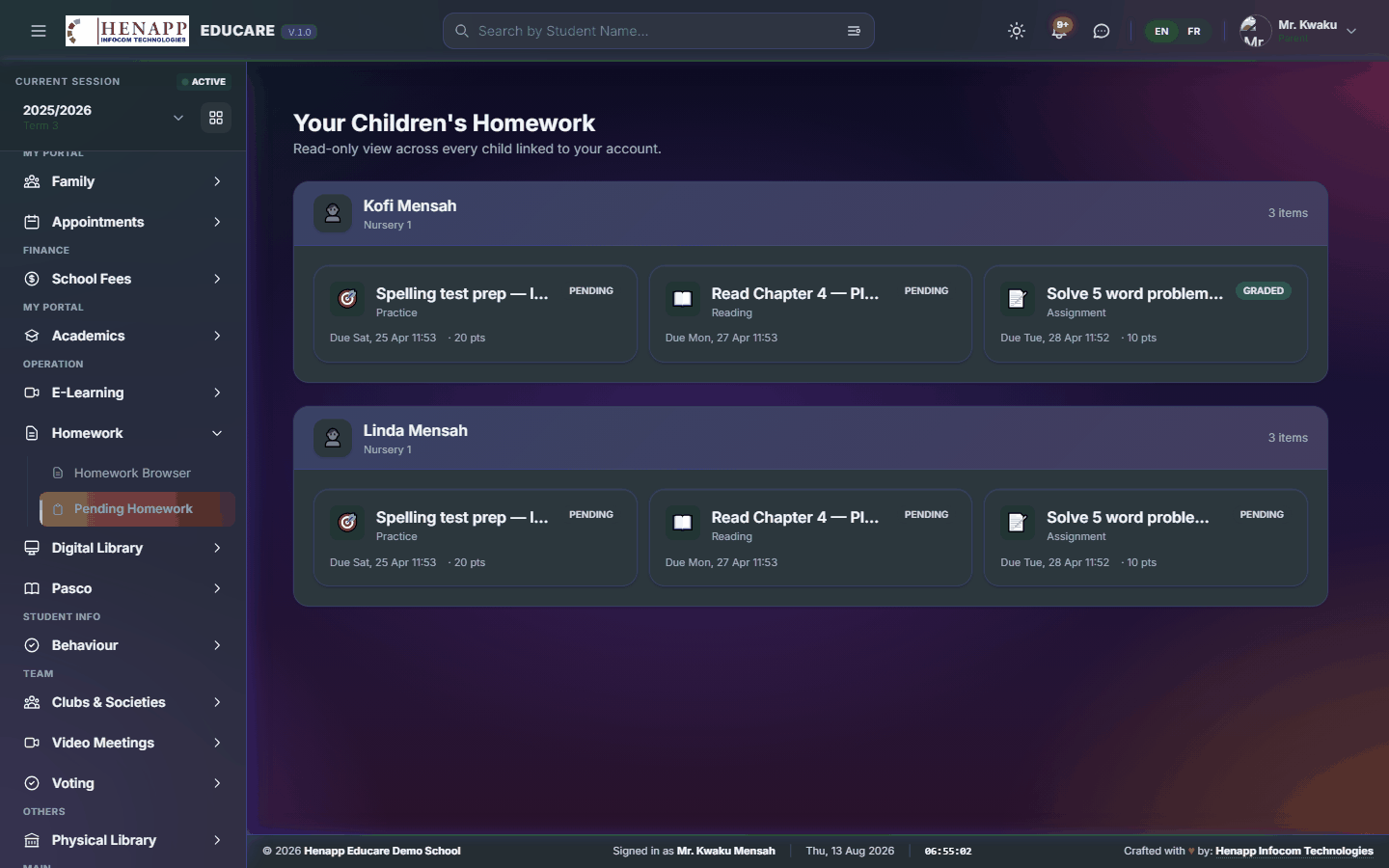
16.2 Pending Homework
Homework still to be done, with the closest deadline first.
How to use it
- Open Homework → Pending Homework.
- Open an assignment to read what is required.
- Do the work, attach your file or type your answer, and Submit.
- Submitted work moves off the pending list.
17. Digital Library
Electronic books and learning games — read in the browser, no download needed.
Find it in the sidebar under Operation → Digital Library.
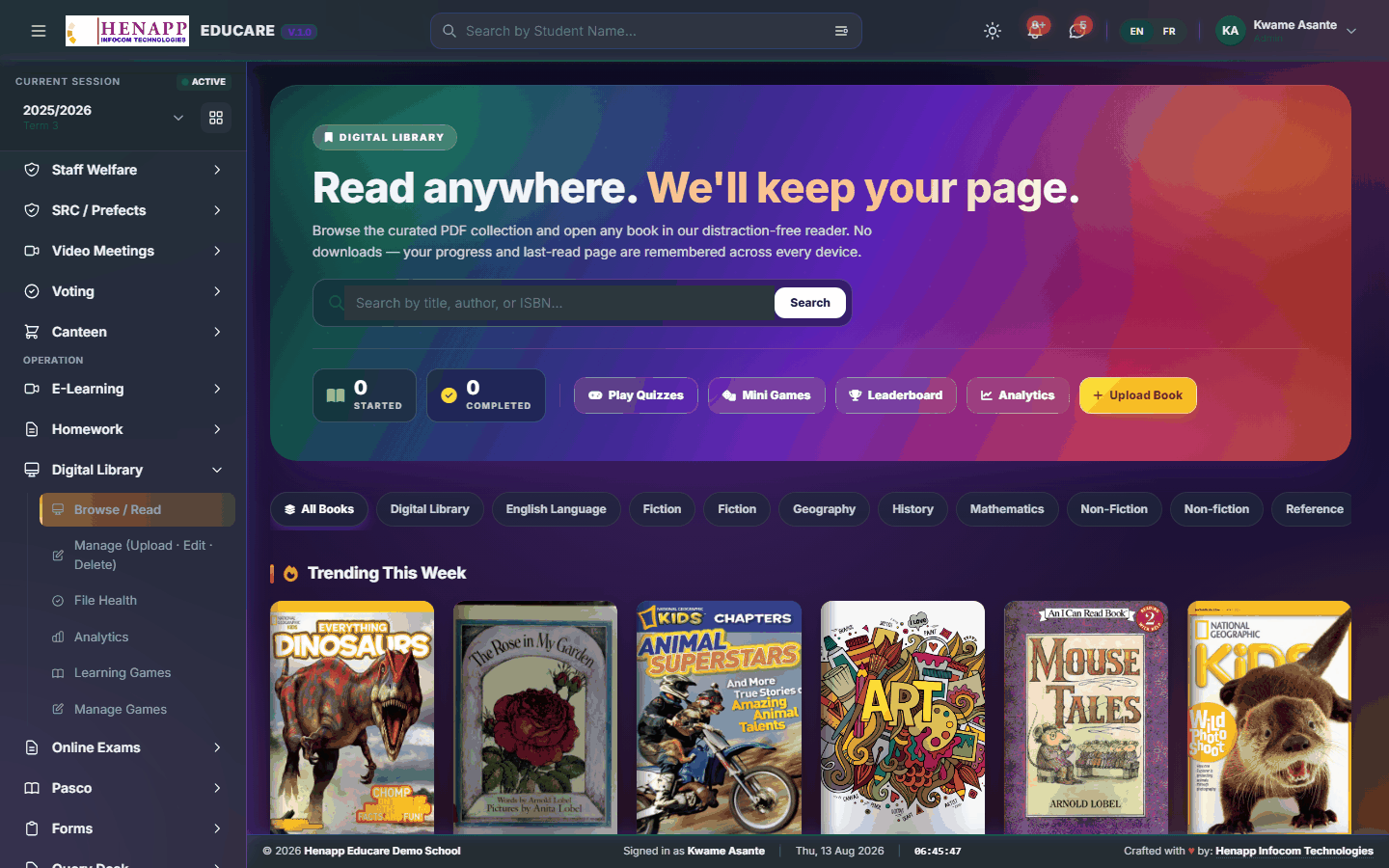
17.1 Browse / Read
The e-book shelf — read in the browser without downloading anything.
How to use it
- Open Digital Library → Browse / Read.
- Search by title, author or subject, or browse the collections.
- Click a book to open the reader.
- Use the arrows or swipe to turn pages; the reader remembers where you stopped.
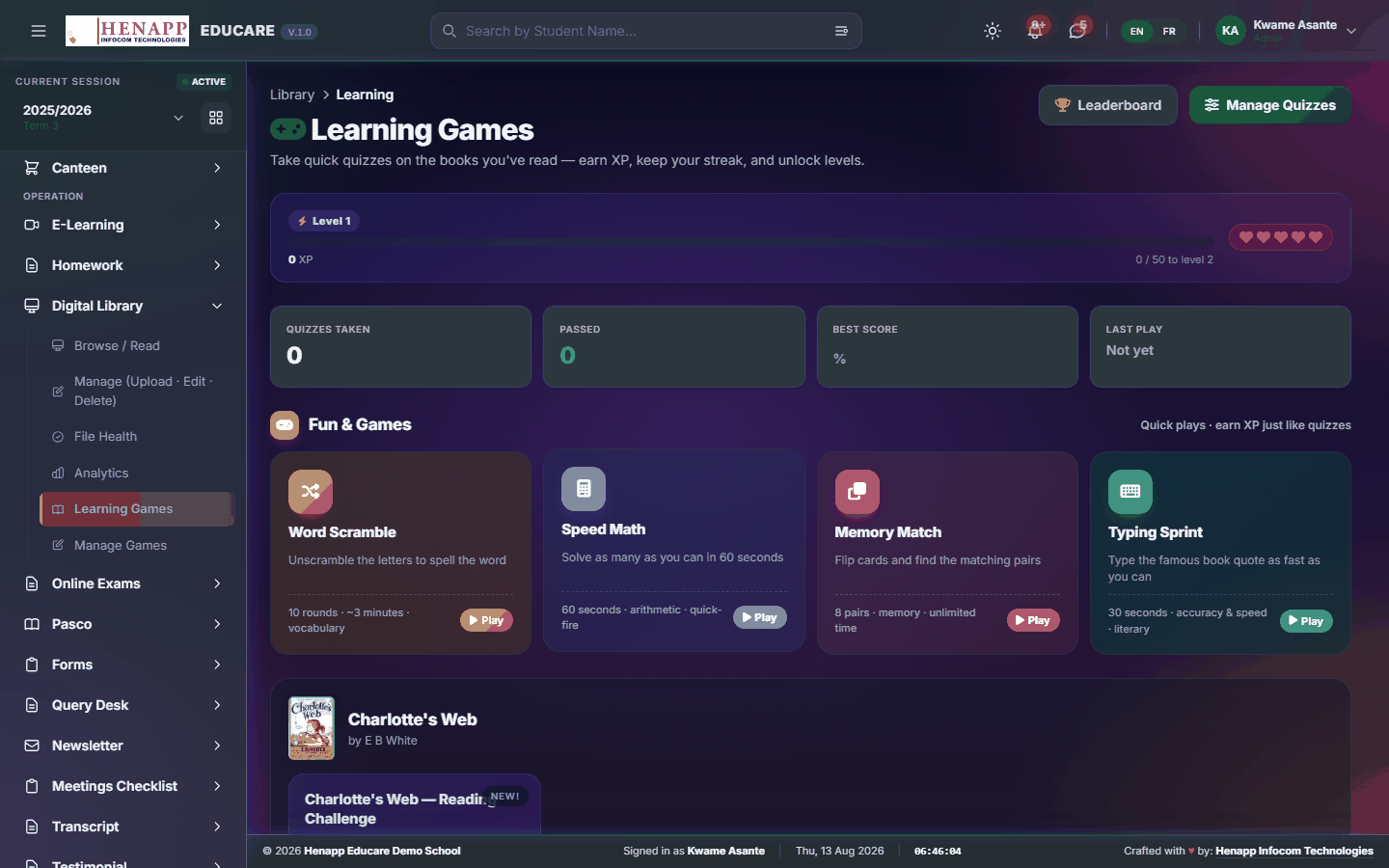
17.2 Learning Games
Educational games and interactive activities for learners.
How to use it
- Open Digital Library → Learning Games.
- Pick a game and play it in the browser.
18. Online Exams
Examinations sat online, from building the paper to releasing the result.
Find it in the sidebar under Operation → Online Exams.
18.1 Online Exams
Sitting an online examination.

How to use it
- Open Online Exams at the scheduled time.
- Click the exam and read the instructions.
- Click Start — the timer begins and cannot be paused.
- Answer each question; your answers save as you go.
- Submit before the timer ends. If time runs out, what you have answered is submitted automatically.
Use a reliable connection and a charged device. If you are disconnected, sign back in quickly — the timer keeps running.
19. Pasco
Past questions, organised by subject and year, for revision.
Find it in the sidebar under Operation → Pasco.
19.1 Pasco (Past Qs)
Past examination papers by subject and year, for revision.

How to use it
- Open Pasco → Pasco (Past Qs).
- Choose the subject and year.
- Open a paper to read it, and download it if you want it offline.
20. Behaviour
Conduct recorded as it happens — merits and demerits against agreed categories, and the rankings that come out of them.
Find it in the sidebar under Student Info → Behaviour.
20.1 Dashboard
Conduct across the school in summary — the pattern, not the individual entries.
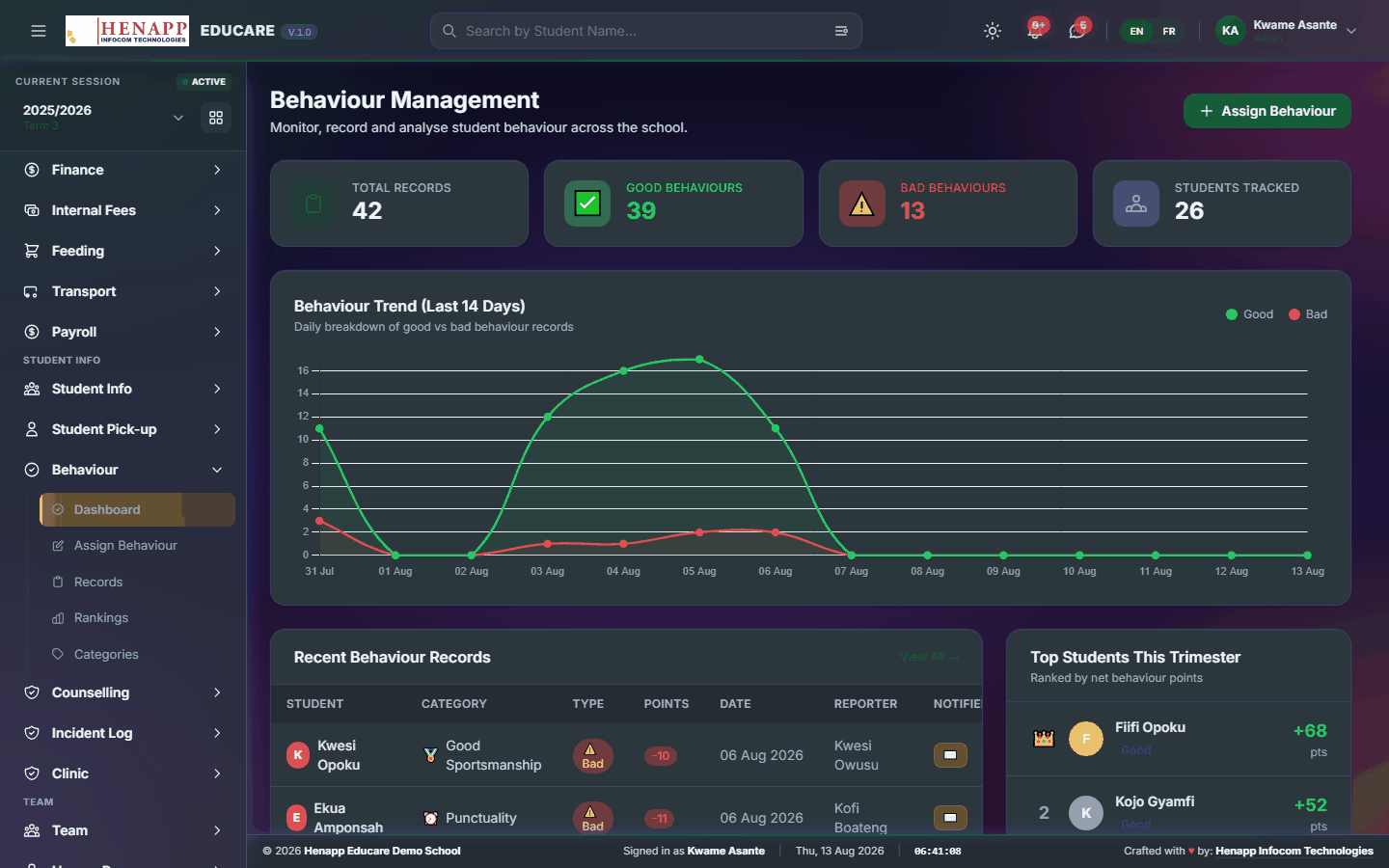
How to use it
- Open Behaviour → Dashboard.
- Read the totals by category and class for the term.
- Click through to the records behind any figure.
20.2 My Behaviour
Your own conduct record — the merits and demerits recorded against you.
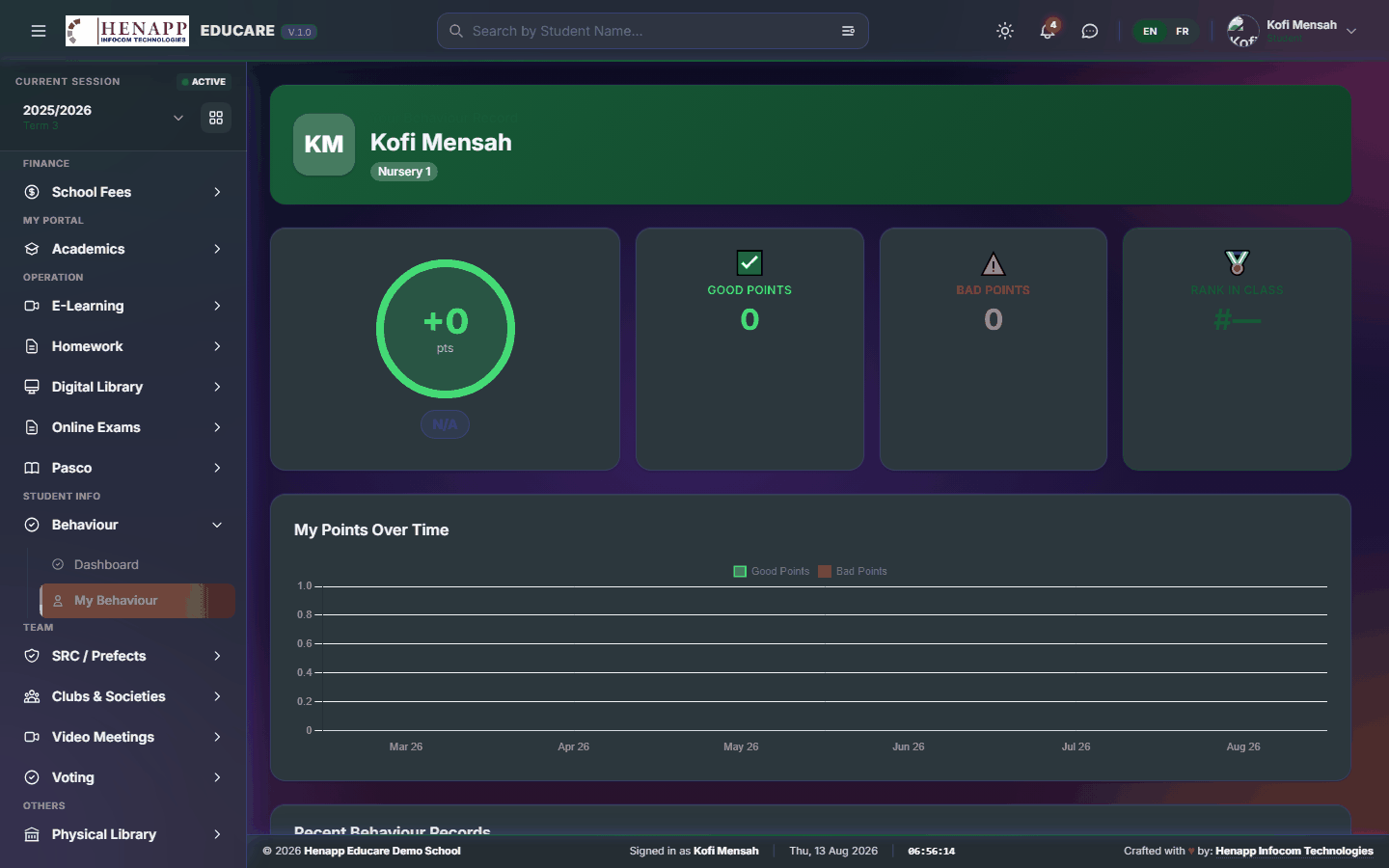
How to use it
- Open Behaviour → My Behaviour.
- Read the entries and your points for the term.
21. Furniture Use
School furniture issued to a named learner — a tagged desk, chair or locker, held for a set period, with its condition and replacement value recorded on the day it is handed over.
The record is only worth what the family knew at the time. The policy is shown to the parent when the item is assigned, and they are asked to acknowledge it; the date and wording they saw are kept with the record.
Condition and value are fixed at handover and never change afterwards. If the item comes back damaged, that is what any charge is worked out against — not what the item is worth today.
Only the school administration may put a figure on damage. A class teacher reports what they see; the amount, and whether to charge at all, is an administrative decision.
A damage charge is added to the learner's bill through Additional Fees, so it appears on their statement and carries forward as arrears until it is paid or written off.
Find it in the sidebar under Student Info → Furniture Use.
21.1 My Furniture
The school furniture you have been given — what it is, its tag, and the condition it was in on the day you were handed it.
How to use it
- Open Furniture Use → My Furniture.
- Check the tag shown here against the tag on the desk, chair or locker you were actually given. If they do not match, tell your class teacher.
- Read the condition it was recorded in. If it was already damaged and that is not what the record says, say so straight away — not at the end of term.
- Read the date you are expected to return it, if one is set.
- Look after it. Tell your class teacher the day anything breaks.
This page is for reading. Agreeing to the furniture policy is done by your parent or guardian on their own login, and so is anything to do with a charge.
If the item is returned damaged, the school may charge part or all of the value written down when it was handed over. That goes onto the family's fees statement, not to you.
Reporting damage early is not getting anyone into trouble. A desk reported the day it breaks can be told apart from one that was already broken; a desk reported in the last week of term cannot.
22. SRC / Prefects
Student leadership: prefect positions, the learners holding them, their forum and their elections.
Find it in the sidebar under Team → SRC / Prefects.
22.1 SRC Dashboard
Student leadership at a glance — positions filled and outstanding.
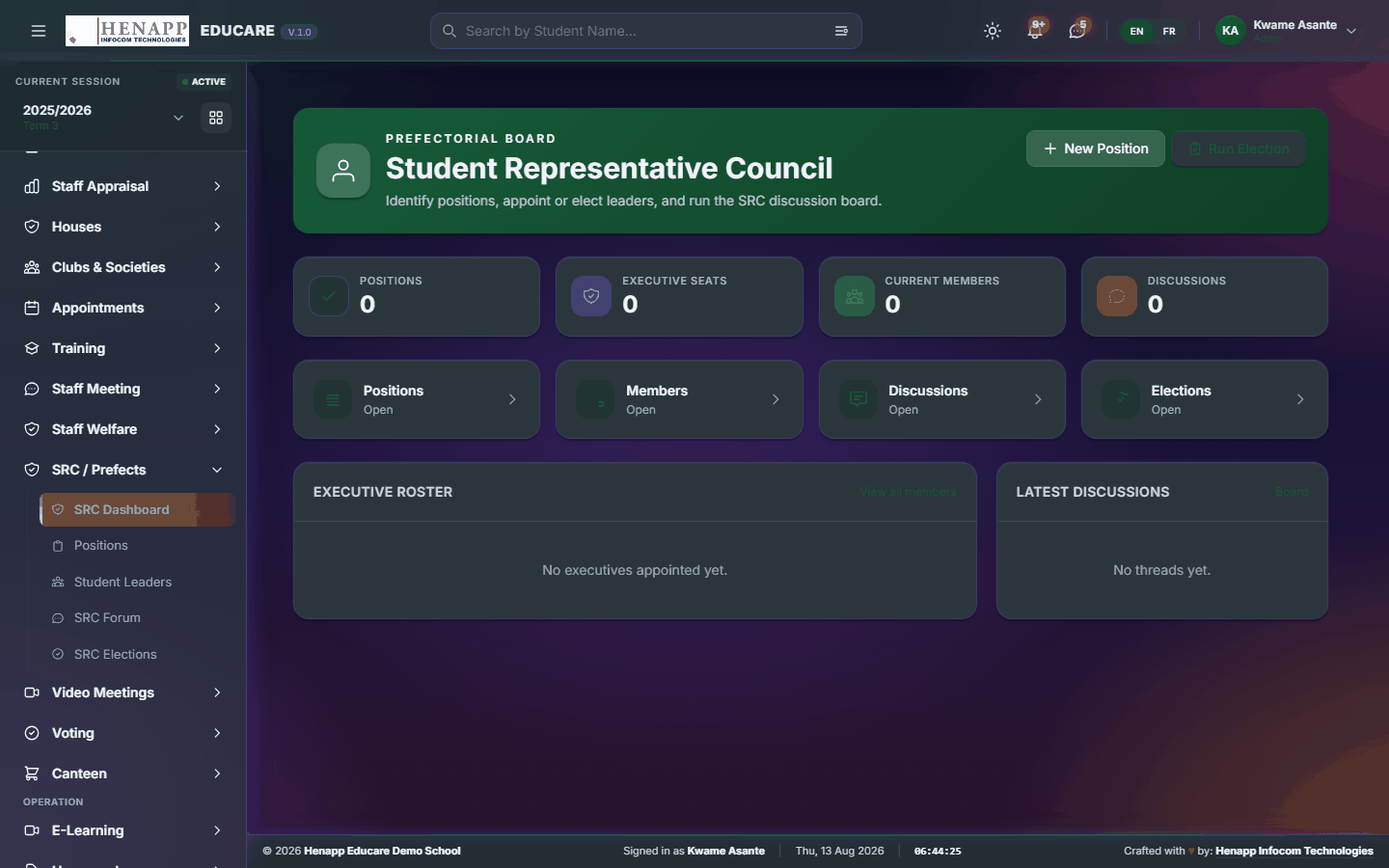
How to use it
- Open SRC / Prefects → SRC Dashboard.
- Read the current leadership and any vacancy.
22.2 Positions
The leadership positions themselves and what each is responsible for.
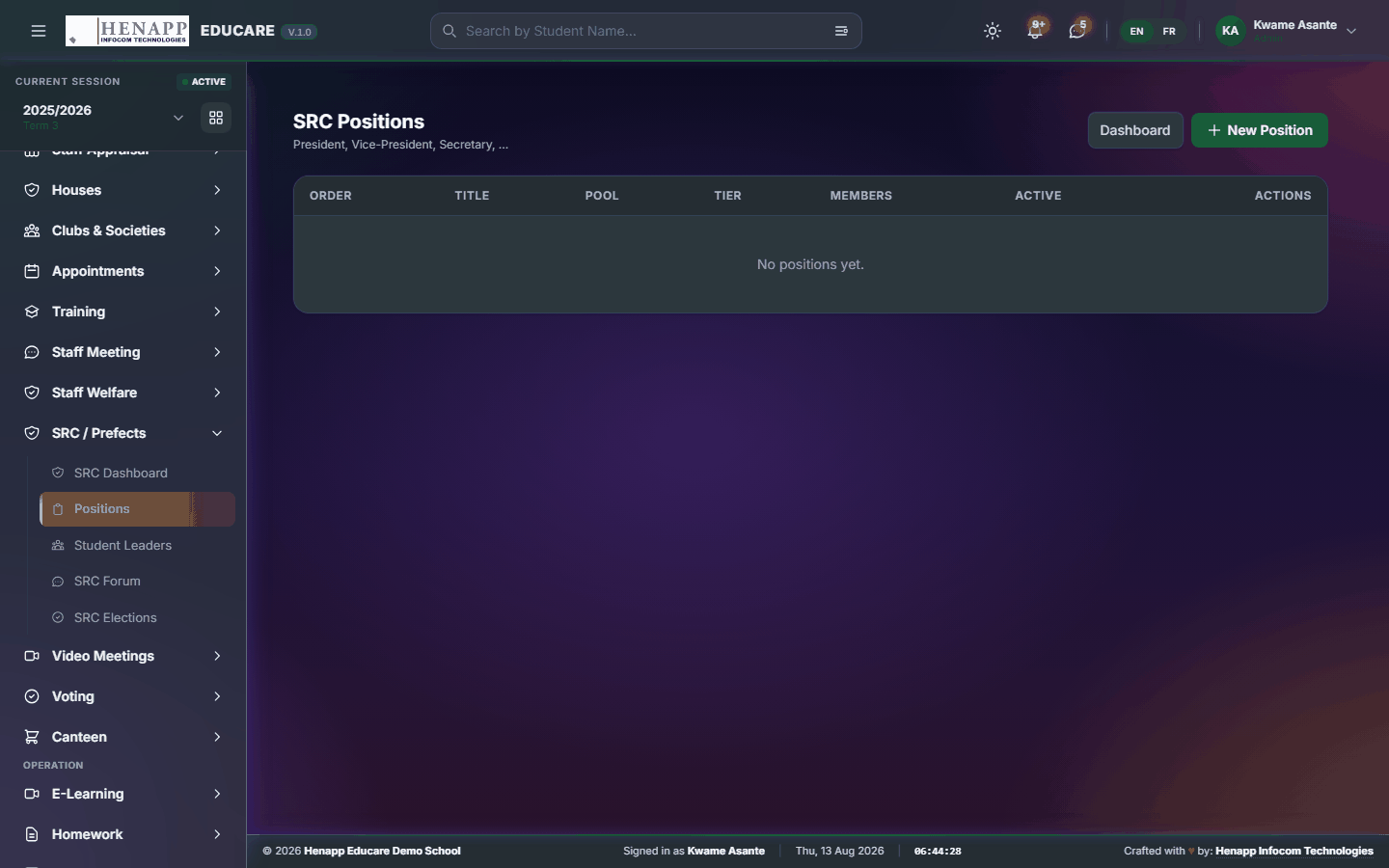
How to use it
- Open SRC / Prefects → Positions.
- Add each position with its title and duties.
- Save.
22.3 Student Leaders
The learners holding each position.

How to use it
- Open SRC / Prefects → Student Leaders.
- Appoint a learner to a position and set the term of office.
- Save.
23. Clubs & Societies
Clubs and societies, and who belongs to each.
Find it in the sidebar under Team → Clubs & Societies.
23.1 All Clubs
The clubs and societies the school runs, with their patrons and meeting times.

How to use it
- Open Clubs & Societies → All Clubs.
- Click Add Club and set its name, patron, meeting day and description.
- Save.
24. Video Meetings
Video meetings scheduled and joined from inside the portal.
Find it in the sidebar under Team → Video Meetings.
24.1 Meetings (Meet/Zoom)
Video meetings scheduled in the portal and joined by one link.

How to use it
- Open Video Meetings → Meetings.
- Click New Meeting and set the title, date and time.
- Choose the platform and paste the meeting link.
- Choose who is invited, then save. They are notified and see a Join button when it is time.
25. Voting
Elections and polls run inside the system, with one vote per eligible voter and a result nobody has to tally by hand.
Find it in the sidebar under Team → Voting.
25.1 Voting Dashboard
Open votes and their turnout.

How to use it
- Open Voting → Voting Dashboard.
- Read the open votes and how many have voted so far.
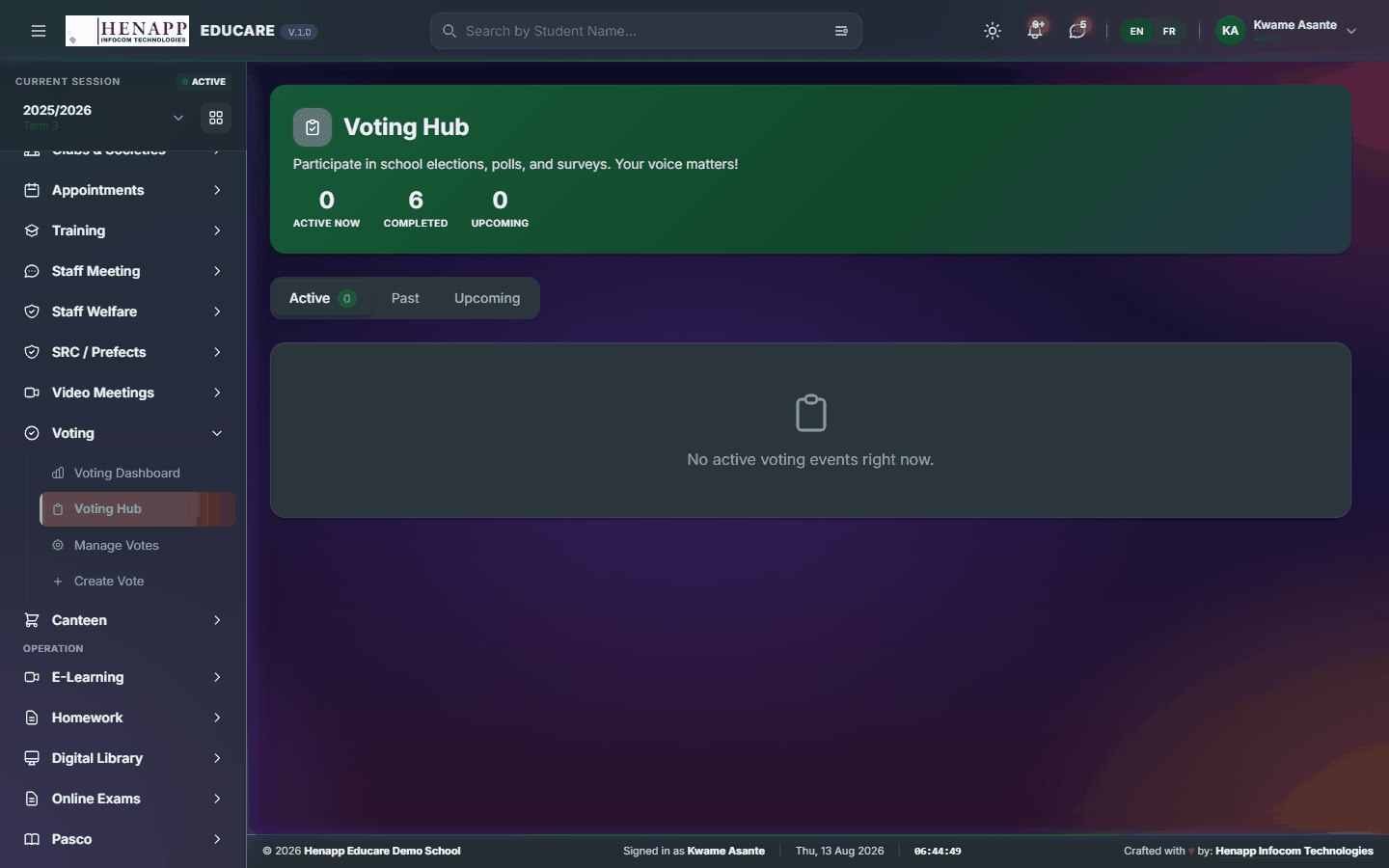
25.2 Voting Hub
Where you cast your own vote.
How to use it
- Open Voting → Voting Hub.
- Open a vote you are eligible for.
- Choose your candidate or option and Submit.
- A vote cannot be changed once submitted, so check before confirming.
26. Physical Library
The physical library — the catalogue, loans and returns, fines and reservations.
Find it in the sidebar under Others → Physical Library.
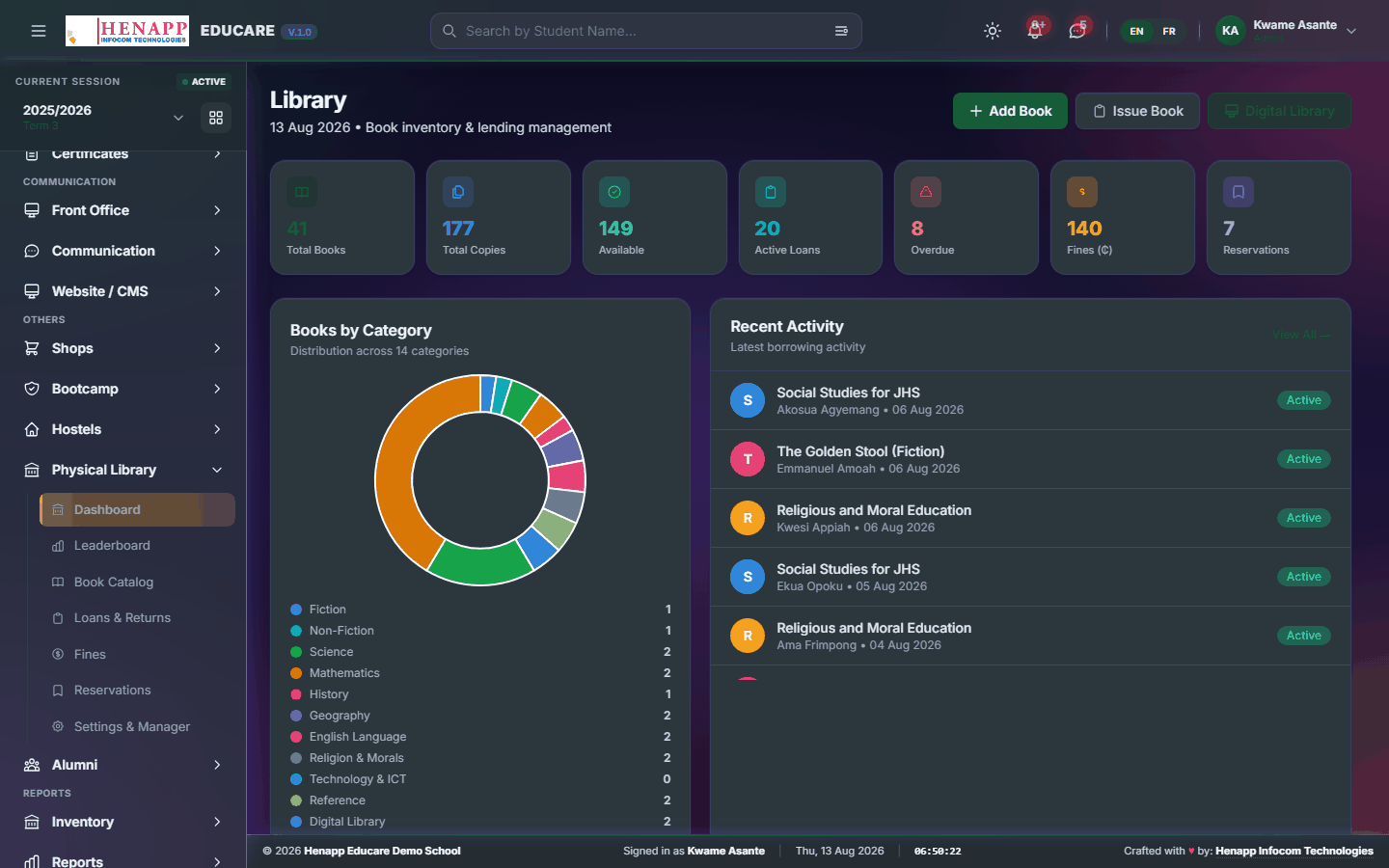
26.1 Dashboard
The library at a glance — books out, overdue and reserved.
How to use it
- Open Physical Library → Dashboard.
- Read the loans, overdue items and reservations.
26.2 Leaderboard
The most active readers, by class and across the school.

How to use it
- Open Physical Library → Leaderboard.
- Choose the period and read the standings.
26.3 Book Catalog
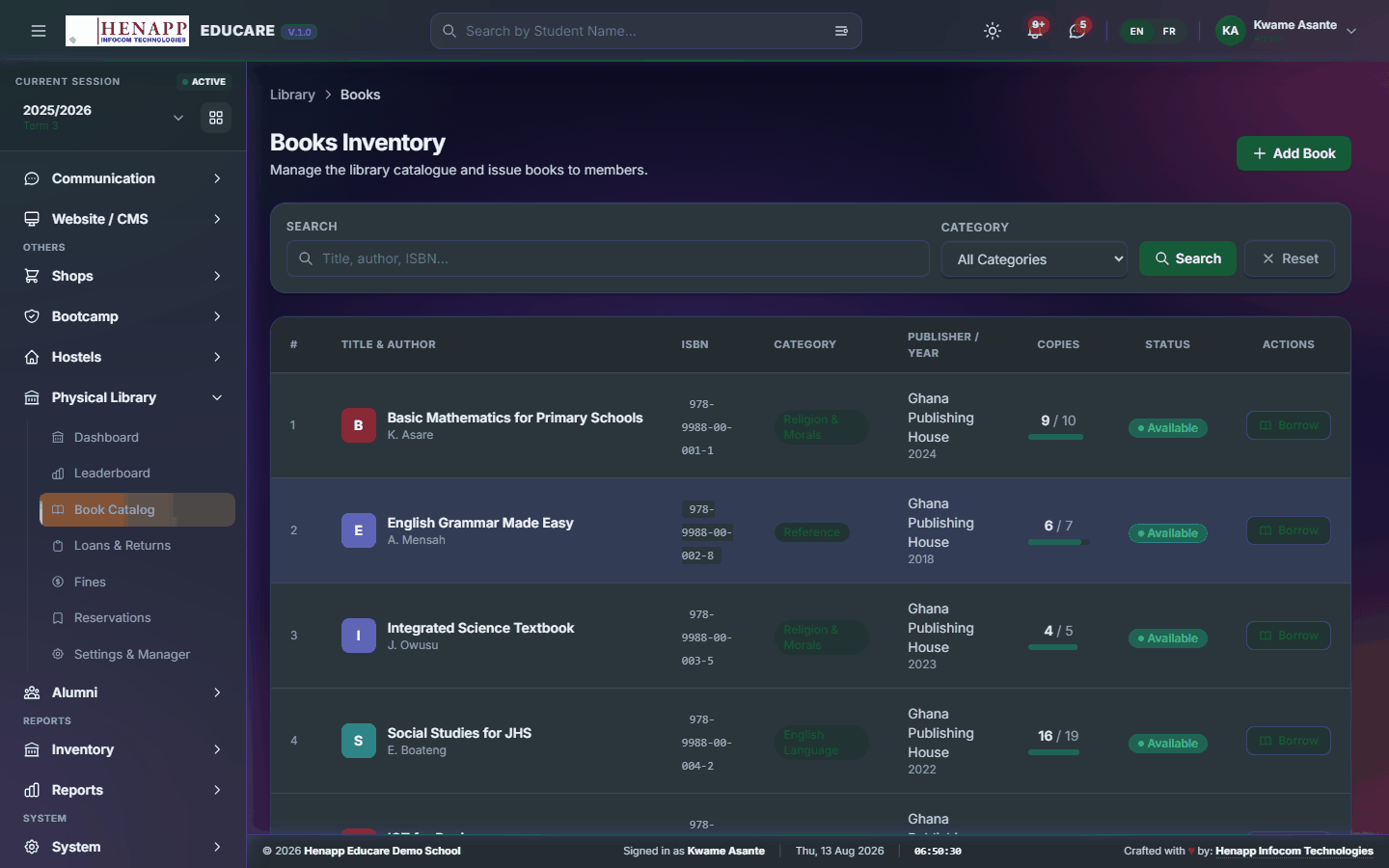
The catalogue — every title held, with its copies and where they are.
How to use it
- Open Physical Library → Book Catalog.
- Click Add Book and enter the title, author, ISBN, category and number of copies.
- Give it a shelf location so it can be found.
- Save. Search or filter the catalogue to find anything later.
26.4 My Orders
Books you have reserved and where you are in the queue.

How to use it
- Open Physical Library → My Orders.
- Read your reservations and their position.
- Cancel one you no longer need.
27. Getting help
If a page does not behave as this guide describes, or you believe you are missing a menu you should have, contact your school office first — most access questions are settled by an administrator adjusting your role.
- A menu is missing — your role does not include it. Ask an administrator.
- A list is empty — check the academic year and term in the top bar before anything else.
- A page refuses to load — sign out, sign back in, and try once more before reporting it.